The floodwater has finally receded from your Pathanamthitta home. What’s left behind is mud-caked flooring, soaked furniture, and scattered debris — and you’re probably wondering where to even start.
“Vellam irangiyallo, ini enth cheyyum?” is usually the very first thought that crosses your mind. It’s completely normal to feel overwhelmed right after a flood, but cleanup gets far more manageable once you tackle it in the right order.
Safety comes first, always. Turn off the main power supply and confirm the house is safe before stepping inside. Once you’ve verified it’s safe to re-enter, clear out standing water and mud first, then move on to washing, disinfecting, and thoroughly drying every affected space.
This guide walks you through post-flood cleaning in Pathanamthitta step by step – covering river mud removal, Veedu Cleaning After Flood, and Kinar Cleaning in Pathanamthitta – so you can bring your home back to a safe, livable state.
What to Do the Moment Water Enters Your Home
When floodwater first enters your house, the instinct is to rush in and start saving belongings or bailing out water. But safety needs to come before cleanup.
- Cut the power right away. Shut off the main electrical board. Never handle switches or plug points with wet hands or while standing in water.
- Shut off LPG cylinders. A gas leak paired with floodwater is a serious fire hazard.
- Don’t go back in until it’s confirmed safe. Check that the structure is stable and there’s no lingering electrical or gas danger.
- Be alert for snakes and insects. Floodwater often pushes snakes, scorpions, and other creatures indoors, so check corners, footwear, boxes, and stored items carefully before handling them.
- Gear up properly. Gumboots, rubber gloves, and a mask matter because floodwater can carry sewage, chemicals, and agricultural runoff.
“Vellam kuranju ennu vech udane veettil kayaralle” Make sure the house is genuinely safe before you begin.
How to Clean Your House After Flood Water Recedes
Once the water has gone down and you know the house is safe to enter, don’t try to tackle the entire cleanup in one go.
Flood cleanup becomes much easier when you work through it step by step. Rushing or missing a stage can leave behind moisture, mould, or unpleasant smells, creating more work later.
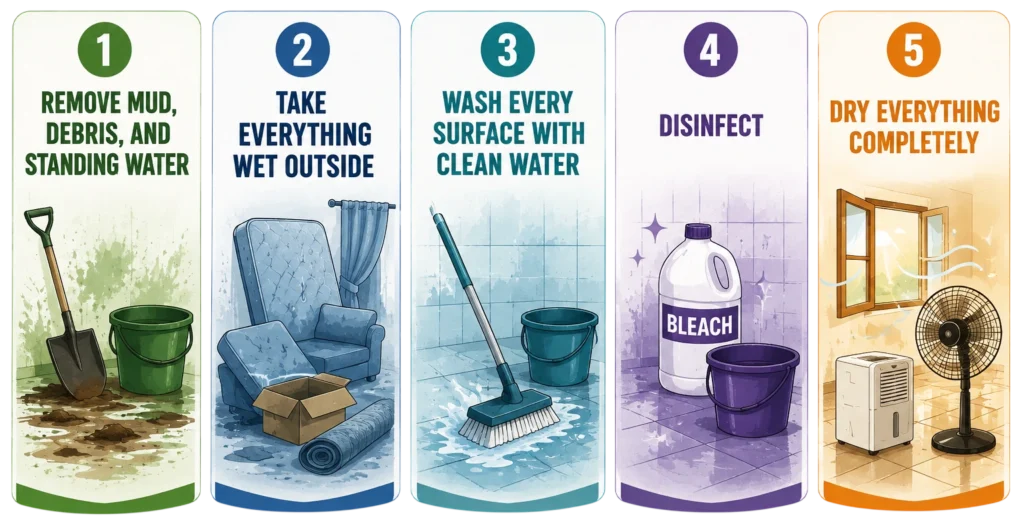
Step 1: Remove Mud, Debris, and Standing Water
Begin by clearing out standing water along with any thick mud and debris.
Buckets, mugs, or a water pump work well for leftover water. If there’s thick river silt, get it out while it’s still wet – once it hardens, it becomes far tougher to scrape off floors, tiles, and grout lines.
“Mud ippol thanne eduthu kalayuka – dry aayaal pani pinne koodum”
Step 2: Take Everything Wet Outside
Carry wet mattresses, sofas, curtains, cardboard boxes, and similar porous items out of the house.
Anything left damp beyond a day tends to grow mould fast. Wooden furniture, steel pieces, and hard plastic items can often be salvaged with proper cleaning and drying, so inspect them before deciding to discard anything.
“Ella saadhanavum throw cheyyenda avashyam illa – save cheyyan pattunnath save cheyyam”
Step 3: Wash Every Surface With Clean Water
Rinse down floors, walls, and fixed furniture using clean water to loosen and remove leftover mud and grime.
Don’t skip this before disinfecting — disinfectant doesn’t work well when it’s applied over a layer of mud.
“Mud undenkil disinfectant direct aayi use cheythittu valiya benefit illa”. Clean the surface first, then move on to disinfection.
Step 4: Disinfect
Once surfaces are visibly clean, it’s time to disinfect them.
For hard, non-porous surfaces like tiles, kitchen counters, and bathroom walls, a diluted bleach solution works well -a commonly used ratio is roughly one part household bleach to nine parts water.
Keep windows and doors open throughout the disinfecting process.
Never combine bleach with ammonia-based cleaners – the resulting fumes can be dangerous.
Step 5: Dry Everything Completely
Thorough drying is one of the most critical parts of post-flood cleanup.
Keep windows and doors open and run fans to boost airflow. A dehumidifier helps too, if you have access to one.
Pay close attention to plastered walls — even when the surface looks dry, trapped moisture underneath the paint can quietly lead to mould.
“Purath dry aayi thonniyal mathram pora; ullilulla moisture koodi full aayi dry aakanam.”
How to Remove River Mud From Floor Tiles
River mud around Pathanamthitta homes tends to be fine and silty, which means it settles easily into grout lines and tile pores once it dries.
“Ithu normal dirt alla – river mud aanu, athukondu kurachu extra care venam”
Follow these steps:
- Clear out loose, wet mud before it has a chance to dry.
- Wet the area with clean water and let it sit for a few minutes.
- Scrub in small sections using a stiff coir or nylon brush.
- For stubborn stains on suitable tile types, a mild acid-based tile cleaner can help — rinse thoroughly afterward.
- Finish off with a bleach-water wipe and let the surface dry.
If the mud has dried and become hard, wet the area thoroughly and let it soak for around 20–30 minutes. Once the mud softens, you can scrub it away more easily without putting unnecessary pressure on the tiles.
Veedu Cleaning After Flood: A Room-by-Room Checklist
Working through the house room by room makes Veedu Cleaning After Flood far more manageable.
| Area | What to Check | Priority Action |
|---|---|---|
| Kitchen | Grain storage, spice boxes, gas connections | Discard any food that came into contact with floodwater |
| Bedrooms | Mattresses, wooden almirahs, wiring | Air out mattresses; have wiring checked before use |
| Bathrooms | Drainage, water tank, tiles | Disinfect thoroughly and check for contamination |
| Living Room | Sofas, electronics, wooden furniture | Dry out electronics and have them inspected |
| Courtyard/Compound | Waterlogging, debris, snake hiding spots | Clear debris and inspect the area carefully |
| Well (Kinar) | Silt and sewage contamination | Do not use until it's cleaned and chlorinated |
“Room by room aayi cheythaal onnum miss aakilla”
Kinar Cleaning in Pathanamthitta: Don't Skip the Well
Plenty of households in Pathanamthitta – particularly in Aranmula, Chengannur, and Pulikeezhu – rely on their own well for daily water needs.
That’s exactly why Kinar Cleaning in Pathanamthitta shouldn’t be skipped during flood recovery.
Floodwater can introduce sewage, farm chemicals, and bacteria into a well, so even water that looks clear shouldn’t be assumed safe.
“Kinarile vellam kaanan clean aayalum, athu safe aanennu urappikkathe use cheyyaruthu.”
Don’t drink or cook with well water until it’s been cleaned and properly tested.
- Pump the well out fully and scrub down the walls.
- Chlorinate using bleaching powder, following local health authority guidelines.
- Have the water tested before using it for drinking or cooking.
Chengannur, Aranmula, and Pulikeezhu Flood Recovery: What's Different Here
Flooding plays out differently across Pathanamthitta depending on the area, since the district straddles the Pampa, Manimala, and Achankovil rivers.
Chengannur Flood Recovery
Chengannur flood recovery often involves agricultural runoff making its way into homes. Extra attention is needed in kitchens and storage spaces where grain and provisions are kept – if food has come into contact with floodwater, it’s safer to discard it.
Aranmula House Cleaning
Aranmula house cleaning presents its own challenges, since many homes sit close to the riverbank and can be affected quickly whenever the Pampa rises.
Traditional wooden furniture and heritage pieces call for gentle, careful drying rather than heavy scrubbing.
“Wooden furniture aanu enkil kurachu care aayi handle cheyyanam”
Pulikeezhu Flood Cleanup
Pulikeezhu flood cleanup frequently involves low-lying residential and paddy areas where water tends to linger longer.
That extended exposure raises the risk of mould, making quick water removal and proper drying especially important here.
DIY Cleaning vs. Professional Post-Flood Cleaning
A question that comes up often after a flood:
“Ithu veettil thanne clean cheyyamo, professional help venamo?”
For light water entry without mud or sewage involved, careful DIY cleaning may be sufficient. But when mud, sewage backflow, or standing water lingers beyond a day, professional cleaning is strongly advised.
| Factor | DIY Cleaning | Professional Cleaning (Smart Zero) |
|---|---|---|
| Time required | 2–4 days | Same-day to 1-day turnaround |
| Equipment | Household tools | Industrial pumps, wet vacuums, sanitising machines |
| Mould prevention | Higher risk if drying is incomplete | Proper drying and anti-fungal treatment |
| Physical risk | Direct exposure to contamination | Trained staff with protective gear |
Health Risks After a Flood and How to Avoid Them
Floodwater can carry sewage, agricultural chemicals, and other contaminants, so a few health precautions matter:
- Leptospirosis (rat fever): Cover any wounds before starting cleanup, and see a doctor if fever develops after flood exposure.
- Diarrhoea and waterborne infections: Stick to boiled or properly chlorinated and tested water until your supply is confirmed safe.
- Dengue and mosquito-borne illness: Clear away stagnant water around the property.
- Mould-related respiratory issues: Dry out wet walls and furniture as quickly as you can to limit mould growth.
“Cleanup cheyyumbol wound undenkil cover cheythittu mathram work cheyyuka”.
If fever, skin infections, or breathing trouble show up after cleanup, see a doctor and mention that you were exposed to floodwater.
Why Homeowners in Pathanamthitta Trust Smart Zero for Post-Flood Cleaning
Smart Zero serves homes and businesses across Ernakulam, Kottayam, Pathanamthitta, Alappuzha, Idukki, Thrissur, Malappuram, and Palakkad.
For flood-affected homes in Pathanamthitta, Smart Zero offers:
- Trained cleaners equipped with protective gear
- Industrial-grade pumps, wet vacuums, and sanitising equipment
- Deep cleaning and disinfection services
- Same-day response, subject to availability
- Coverage across Thiruvalla, Aranmula, Chengannur, Pulikeezhu, Ranni, Konni, and Pandalam
“Veedu safe aakki edukkanam enkil cleaning proper aayi cheyyunnathaanu most important”.
If your home urgently needs post-flood cleaning, call Smart Zero and book a flood cleanup slot in Pathanamthitta district.
Conclusion
A flooded home can feel like a lot to take in — mud everywhere, soaked furniture, damaged belongings. “Evide ninn thudanganam?” is a completely natural reaction.
But post-flood recovery isn’t just about making the house look clean again – it’s about making your veedu safe, dry, and comfortable to live in once more. Whether you’re in Aranmula, Chengannur, Thiruvalla, or Pulikeezhu, getting the early steps right can make the whole recovery process much smoother.
And if handling it all on your own feels like too much, Smart Zero is ready to help with professional post-flood cleaning, deep cleaning, and disinfection.
“Flood kazhinju veedu normal aakkan time edukum, pakshe proper cleaning cheythal recovery smooth aakkaam”
FAQs
1.How soon should I start cleaning my house after flood water recedes?
Begin as soon as it’s officially declared safe to go back in — ideally within 24–48 hours.
2.What is the correct bleach-to-water ratio for disinfecting a flooded home?
A commonly used ratio is about one part household bleach to nine parts water for hard surfaces. Keep the area ventilated, and never mix bleach with ammonia.
3.Can I save a mattress or sofa that got wet in the flood?
If it remained wet for more than 24–48 hours, mould has likely developed inside the padding, making it hard to save safely.
4.Can you use well (kinar) water immediately after a flood?
No. The well needs to be pumped out, cleaned, chlorinated, and tested before it’s used for drinking or cooking.
5.How do I remove dried mud stains from floor tiles?
Soak the area with water for 20–30 minutes, then scrub with a stiff brush. Avoid scraping dry mud directly, as it can damage the tile.
6.Do I need professional cleaning, or can I manage flood cleanup myself?
Minor water entry without mud may be manageable through DIY cleaning. Mud, sewage backflow, or water that’s stood for a long time calls for professional help.
7.What health symptoms should I watch for after flood cleanup?
Keep an eye out for symptoms like fever, skin infections, or difficulty breathing.
8.Does Smart Zero provide urgent flood cleaning in Aranmula, Chengannur, and Thiruvalla?
Yes, Smart Zero covers the Pathanamthitta district, including Aranmula, Chengannur, Thiruvalla, Pulikeezhu, Ranni, Konni, and Pandalam.
 Commercial Cleaning
 Residential Cleaning
 Industrial Cleaning
 Housekeeping
 Office cleaning
 Normal Cleaning
 Deep Cleaning
 Carpet Cleaning
 Glass Cleaning
 Disinfection and Pest Control